
To have a purpose, to be needed, to feel important to others. These may not make the essentials list like food and water but our personhood is deficient without them. Once a child can feel even the smallest bit of purposefulness to his parents, he’s on it! When Roman was barely 2 he used to soak himself ‘doing the dishes’. His scrubbing skills weren’t refined but I could get quite a bit done while he sloshed around on a stool at the kitchen sink. As kids grow, they become less interested in being “mommy’s little helper’ as that desire to becomes more selective. Getting our kids to do chores around the house these days is the proverbial teeth-pulling exercise. But a few weeks ago, Abe, Dane, and Roman had the opportunity to be ‘water boys’ on the sideline for the Cathedral Catholic High School football game and I guarantee you’ve never seen a group of more motivated humans.
Watching them from the top of the stands during the pre-game ceremonies, I was unsure what the Rhodes boys would actually be doing. They practiced filling water bottles at the tank and then roamed the sidelines somewhat aimlessly for the first few minutes of the game. I was concerned boredom might become a factor and who knows what else after that. But when the first timeout was called on the field, to my utter surprise, Dane burst through the mass of red and yellow crowding the sideline, waddling into the huddle with a carrier full of water. There he was, in the middle of the field at the 25 yard line, bouncing around, poking a Gatorade bottle into every hand that would take one as the offense prepared for their next series. I could almost feel Dane’s pleasure when a player patted his head in gratitude as he headed back to the sideline. This went on the entire game as they took turns filling bottles and racing around making sure the Dons were hydrated.
The boys were so zoned into their job that when the team headed to the locker room at halftime, they followed the herd! We scrambled from our seats in the bleachers trying to figure out a way to head them off, certain they were to hear and see things we typically try to avoid. But they disappeared in the flow of players and coaches and all we could do was laugh, counting the minutes until they would emerge with what stories to tell! As the team returned to the field with a steady jog, our boys joined in, chests out as if the crowd was cheering for them.
The ‘water boys’ psyched for the second half.
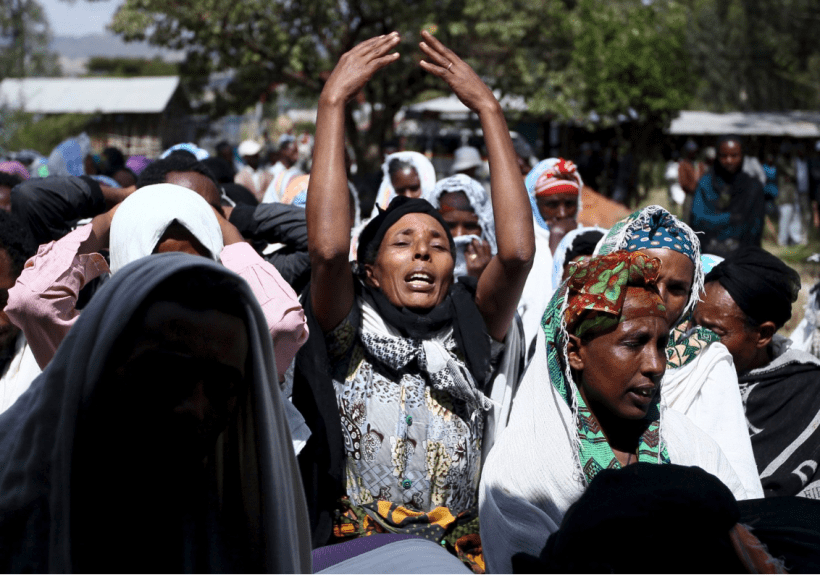
I can’t help thinking of their experience when I consider the unrest that has overtaken Ethiopia the last few weeks.
Returning from Ethiopia September 18, I was encouraged by my meetings with our partners. “Things” are headed in the right direction. Our goals of a movement characterized by people embracing abundant life is still intact. The Savings Group program is close to running and expanding itself without paid facilitators (what we’ve been supporting for 5 years). Leaders are leading people to lead people to Jesus and train new leaders among those following him. I gained confidence meeting a new regional director for the organization supporting our small business development. There were more positives but beyond all this, the stirring of civil unrest rooted in years of tribal and political conflict was most impactful.
Short explanations don’t paint a full picture but this summary may help:
(Read the entire article for a fuller understanding of the situation.)
On the surface, my travel was the same as usual. The only sign of protests or property damage was in the rumors sprinkled throughout my conversations with the nationals. But in the last few weeks, conditions worsened and caused alarm when places we are very familiar with became the flashpoint of turmoil. I wasn’t concerned for my safety three weeks ago but if my trip began today, I would probably choose to stay in Addis Ababa where security is highest.
It took several years of visiting before I started to understand a bit of Ethiopia’s history and contemporary political and economic environment. I always had lots of questions driving through the countryside, especially as I learned nearly every factory or large farm is foreign-owned. And as I’ve written before, my excitement about the new expressway was tempered with concern for the rural villages it seemed to slice through, even though it reduced our drive time.
I’m not naive about the growing pains nations experience climbing out of subsistence living. Modernization and industrialization is surely to discomfort some and unsettle traditional living practices. The question is whether this process is a ‘rising tide lifting all boats’ or a tidal wave that wreaks havoc on the poor, weak, and vulnerable. ‘Successful’ nations like ours have flaws and made considerable mistakes along the way to prosperity. But there’s a reason the West continues to attract millions of immigrants whether they are well-received or not. There is an essence that inspires the pursuit of the American Dream that I contend hasn’t been unlocked yet in Ethiopia.
I often wonder whether families in the Arsi and Bale zones away from the cities are much aware of the government’s development plans or foreign investment that haven’t affected them directly yet. After years of observation, I can’t imagine a farmer has time to concern himself with much else other than his daily survival. Nevertheless, I’ve witnessed a discontent in the villages of Arsi Negele that is likely found in the hearts and minds of those in the crowds of protesters.
The millions who haven’t benefited from the rapidly rising Ethiopian GDP feel undervalued. Even if the ruling party see themselves as benefactors helping these poor rural masses stuck in the pre-industrial era, their paternalistic ways adds to the low self-worth that pervades the culture. Add a real or perceived oppression that silences opposition, and you create a volatile situation we are seeing play out now.
This antithesis is found in one Muhamed, of the thresher owners Discovering Light helped to start a business in 2012. Muhamed found out I was in town last month and wanted to make sure he could see me at least for a few minutes. He was so excited to share his success, and how he’d used his earnings to start a taxi business, offering driving services between harvest seasons. Our loan four years ago did more than just give him an income-generating opportunity. We affirmed his inherent worth. The program wasn’t close to perfect. But it gave Muhamed a purpose, a path to serve and demonstrate his value daily to others and himself.

The combination of joy and determination that characterized Abe, Dane, Roman on the Cathedral Catholic sideline is a microcosm of Muhamed’s experience over the past few years. There’s very few motivators as powerful as feeling important and useful. The satisfaction of a good job is in far more than just material benefit. That sense of purpose must be unleashed throughout Ethiopia for there to be sustained peace and true prosperity. The Savings Group program we support always starts with the poorest of the poor to break down class barriers and send a message that anyone can lift themselves up, serve their neighbors, and be the agent of change in their community.
Any development that fails to empower the least as well as the greatest will be hollow. It’s easy to see why. Just imagine the trouble if we had told Dane he wasn’t cut out to be a water boy and he had to watch Roman and Abe have all the purposeful fun. The Oromo, Amhara, Tigray, and other tribes all have the same desires. They don’t want to be left out, spectators in the development of their communities. Every Ethiopian deserves to be treated as inherently valuable and worthy contributors to the advancement of their nation. May it be so.
Pray for Ethiopia in this state of uncertainty (as well as Emergency).
 Keep Your Eye on the Rhodes